Introduction
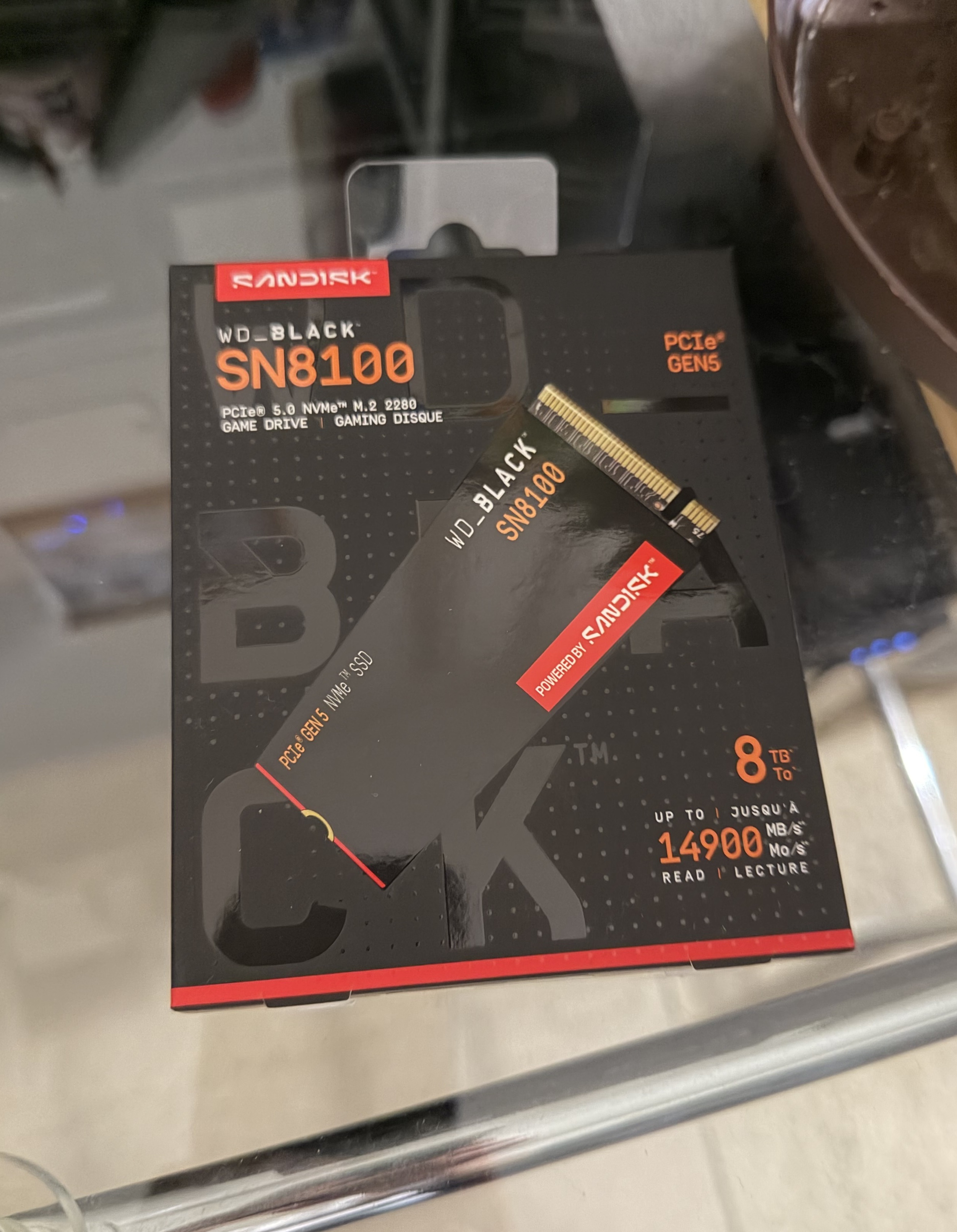
There are currently as of this writing two 8TB PCIE Gen 5 M.2 NVME drives on the market: the Samsung 9100 Pro, which has been avaliable for a few months, and the Sandisk SN8100, which appears to just have recently become avaliable this month. There are benchmarks avaliable for the 8TB 9100 Pro and for the smaller capacity variants of the SN8100, but no benchmarks avaliable for the new 8TB SN8100.
Avaliable benchmarks seem to indicate that the SN8100 has the advantage over the 9100 Pro in smaller capacities, but this may not be true at larger capacities. I have decided to test these two drives myself and publish the results since there are currently no publicly avaliable ones.
Test System
The test was conducted with both NVME drives inserted into M.2 slots that had direct connection to the CPU PCIE lanes, running with x4 lanes of Gen 5 speeds. I tested both drives on NVME Gen 5 speeds, and did tests with active cooling on the SSDs to see how they performed without thermal throttling. I did four rounds of each tests and took the average across all four tests.
| Part | Component |
|---|---|
| CPU | AMD Ryzen 9 9950X3D |
| RAM | 96GB DDR5 @ 6400MT/s and CAS 38 |
| Motherboard | Asus ProArt X870E |
| GPU | Nvidia RTX 5090 FE |
| Power Supply | Corsair AX1600i |
| SSD | Samsung 9100 Pro 8TB |
| SSD | Sandisk SN8100 8TB |
Results and Discussion
CrystalDiskMark 9.0.1 x64 with Test Count 9, and Test Size 64 GiB, all drives formatted with GPT and a 90% NTFS partition, with 10% left unpartitioned (overprovisoned) on both drives.
I did four runs for each set of tests and took the average across all four. I also conducted a set of tests with and without BitLocker encryption, along with a hardware encryption test on the 9100 Pro.
| Sandisk SN8100 8TB (No BitLocker) | ||
|---|---|---|
| Benchmark | Read (MB/s) | Write (MB/s) |
| SEQ1M Q8T1 | 14909 (MB/s) | 13248 (MB/s) |
| SEQ1M Q1T1 | 9159 (MB/s) | 10974 (MB/s) |
| RND4K Q32T1 | 1042 (MB/s) | 949 (MB/s) |
| RND4K Q1T1 | 113.85 (MB/s) | 325.05 (MB/s) |
| Samsung 9100 Pro 8TB (No BitLocker) | ||
|---|---|---|
| Benchmark | Read (MB/s) | Write (MB/s) |
| SEQ1M Q8T1 | 14840 (MB/s) | 13330 (MB/s) |
| SEQ1M Q1T1 | 9794 (MB/s) | 8198 (MB/s) |
| RND4K Q32T1 | 831 (MB/s) | 706 (MB/s) |
| RND4K Q1T1 | 92.22 (MB/s) | 304.17 (MB/s) |
The Sandisk SN8100 8TB has a clear advantage in performance, with a 22% advantage in Random 4K read and a 7% advantage in Random 4K write. I also observed lower power consumption by 1~ watt when benchmarking on the Sandisk. Let's take a look at performance with software encryption:
| Sandisk SN8100 8TB (Software AES-256 BitLocker) | ||
|---|---|---|
| Benchmark | Read (MB/s) | Write (MB/s) |
| SEQ1M Q8T1 | 14858 (MB/s) | 12857 (MB/s) |
| SEQ1M Q1T1 | 5456 (MB/s) | 6133 (MB/s) |
| RND4K Q32T1 | 460 (MB/s) | 545 (MB/s) |
| RND4K Q1T1 | 82.98 (MB/s) | 136.95 (MB/s) |
| Samsung 9100 Pro 8TB (Software AES-256 BitLocker) | ||
|---|---|---|
| Benchmark | Read (MB/s) | Write (MB/s) |
| SEQ1M Q8T1 | 14821 (MB/s) | 13075 (MB/s) |
| SEQ1M Q1T1 | 6616 (MB/s) | 5894 (MB/s) |
| RND4K Q32T1 | 398.02 (MB/s) | 507.30 (MB/s) |
| RND4K Q1T1 | 73.90 (MB/s) | 112.46 (MB/s) |
Yikes! Software based BitLocker has severely degraded performance across both drives, especially in random 4K performance. Random 4K write performance is degraded to as much as a third of its original performance! Let's take a look at performance with hardware based BitLocker on the 9100 Pro. The SN8100 does not support IEEE1667, a prerequisite for hardware BitLocker.
| Samsung 9100 Pro 8TB (Hardware BitLocker) | ||
|---|---|---|
| Benchmark | Read (MB/s) | Write (MB/s) |
| SEQ1M Q8T1 | 14832 (MB/s) | 13392 (MB/s) |
| SEQ1M Q1T1 | 9720 (MB/s) | 10354 (MB/s) |
| RND4K Q32T1 | 798 (MB/s) | 658 (MB/s) |
| RND4K Q1T1 | 96.02 (MB/s) | 311.74 (MB/s) |
The Samsung 9100 Pro performs identically (within margin of error) with hardware BitLocker as being tested unencrypted.
Conclusion
For unencrypted filesystem workloads, the Sandisk SN8100 is clearly better. It achieves consistently higher random random 4K read and write by about 22% and 7% respectively when compared to the Samsung 9100 Pro. However, when software BitLocker is enabled, performance on both drives craters. I did not test with LUKS but I strongly suspect the numbers will be similar. The Samsung 9100 Pro supports IEEE1667, a prerequisite for hardware BitLocker, whereas the Sandisk SN8100 only supports TCG OPAL v2.02, which has been largely relgated to UEFI implementations in the PBE.
If hardware BitLocker encryption is employed, the Samsung 9100 Pro is the clear winner. It achieves the same performance as no encryption, enabling a 15% advantage over the SN8100 in random read 4K and a 230% improvement in random write 4K!
Ultimately, the drive of choice will depend on whether hardware encryption is possible for you or not. If it is, the 9100 Pro is likely better, and if not, the SN8100 is likely better. TCG OPAL is unfortunately a largely opaque specification. The most common implementations of it are in vendor specific UEFIs, such as HP's DriveLock. The hardware encryption in the SN8100 may be an option for you if your UEFI has an implementation for TCG OPAL.
Afterword
Feel free to contact me for more infomation. You can find my email in my about me.
No AI or LLMs were involved in this writing in any way, shape or form.